UB/SF-IIA1

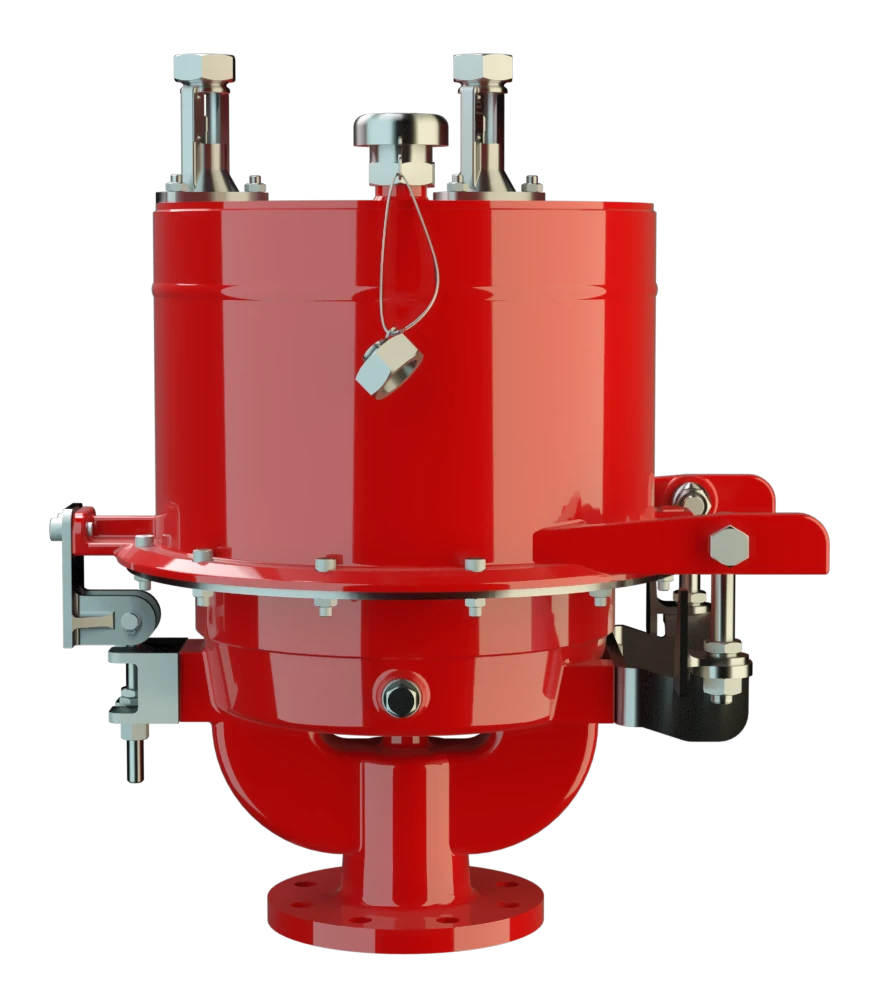
Pressure/Vacuum Diaphragm Valve with internal coating, deflagration- and endurance burning-proof
Features

Estanqueidade extrema
Resulta nas menores perdas possíveis de produto e na redução do impacto ambiental
Manutenção ideal da pressão
Pressão de ajuste próxima à pressão de abertura para manutenção ideal da pressão no sistema
Sistema de proteção conforme ATEX
Pode ser utilizado como sistema de proteção em áreas com atmosfera potencialmente explosiva, conforme ATEX
Monitoramento digital de nível
Monitoramento digital de nível disponível para otimizar os intervalos de manutenção
Sensores digitais de nível
Sensores digitais de nível podem ser instalados posteriormente em válvulas já instaladas
À prova de congelamento
Proteção ideal contra congelamento
Drenagem de condensado
Dreno automático de condensado
Monitoramento
Monitoramento do líquido de carga por indicador de nível
Design modular
Permite a substituição e a limpeza de FLAMEFILTER® individual
Monitoramento operacional simples
e manutenção por simples abertura da tampa articulada da válvula
Segurança contra combustão prolongada
Proteção contra deflagração atmosférica e combustão prolongada
Ventilação segura
Ventilação do corta-chamas e respiro da câmara pressurizada
Function and Description

Combined Pressure and Vacuum Relief Valve
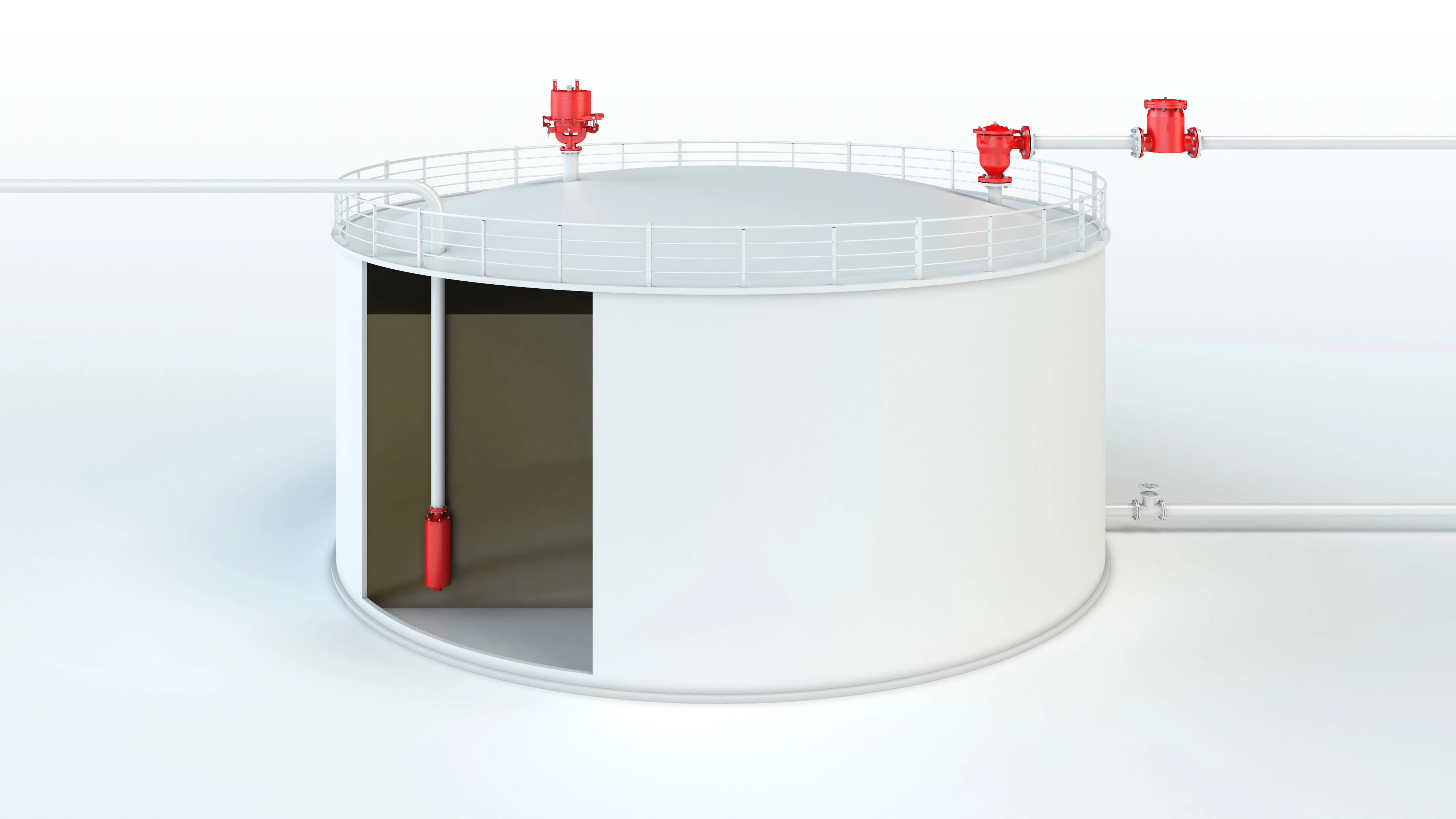
The Deflagration-Proof and Endurance-Burning-Proof PROTEGO® UB/SF-IIA1 type diaphragm Membrane A diaphragm is a thin layer of material, which has a large surface area. valve is a state of the art pressure and vacuum Dépression Vacuum is the pressure in an enclosed space that is lower than the ambient pressure. - relief valve combining the function of a dynamic Flame Arrester. Worldwide this design is unique. It is primarily used within biogas plants as a device Appareil A device is a pipe component that influences the media flow by opening, closing, or partially shutting off the flow channel or by dividing or mixing the media flow. for flame transmission proof in- and outbreathing on tanks, containers and process engineering apparatus. The valve offers reliable protection against excess pressure and vacuum, prevents the inbreathing of air and product losses almost up to the set pressure Pression de réponse Set pressure is the gauge pressure at the device inlet at which the relief device is set to start opening under service conditions. and protects against atmospheric deflagration and endurance burning Endurance burning Stabilized burning for an unlimited time. if stabilized burning occurs.

Usable Under Extreme Climatic Conditions
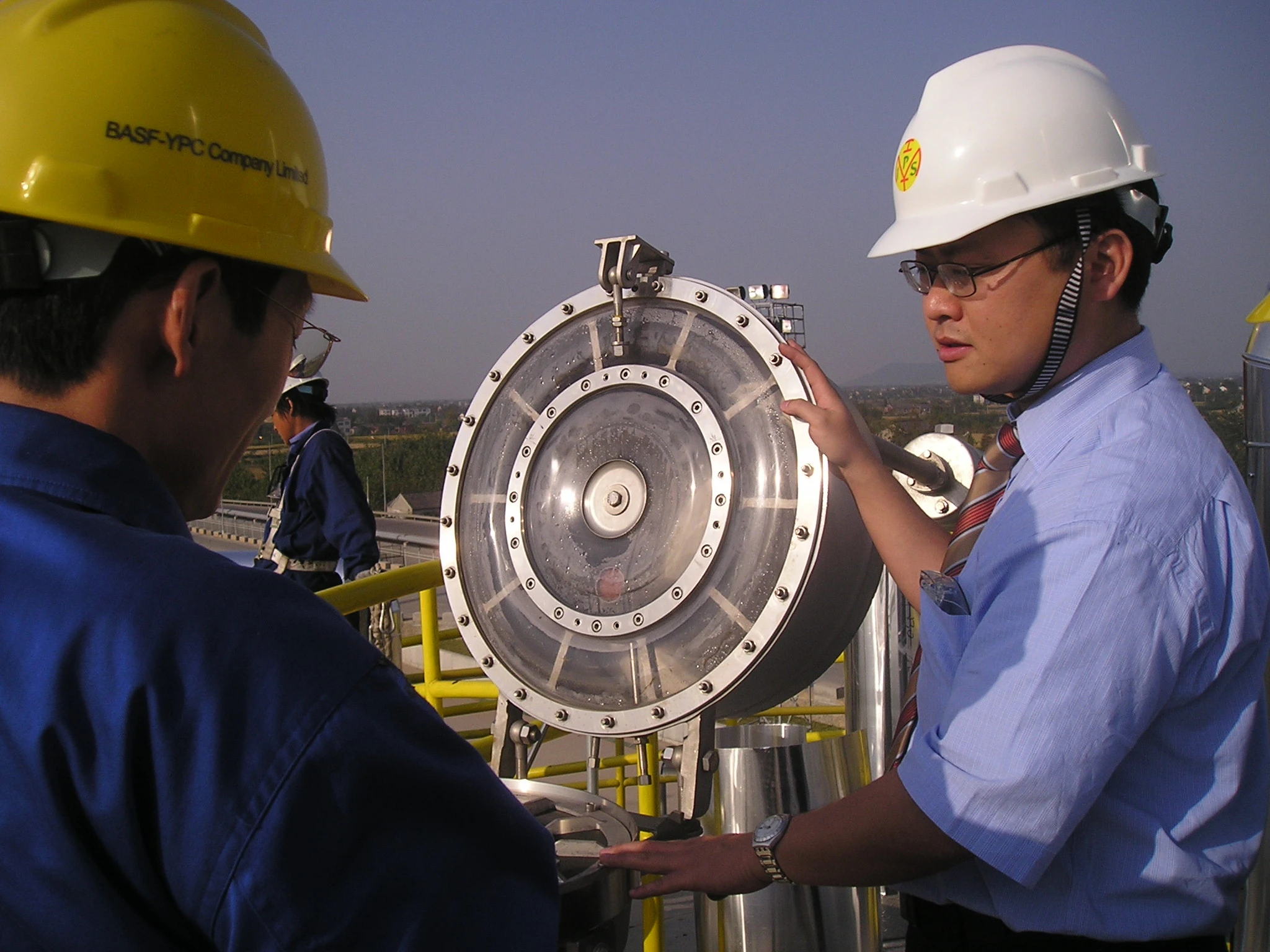
The set pressure is adjusted with a freeze resistant water glycol mixture, which assures safe operation under extreme cold weather conditions. The liquid is capsuled and is not discharged or diluted during operation. The valve can also be operated at temperatures lower than 0°C without ice constricting the function of the valve.

Composition

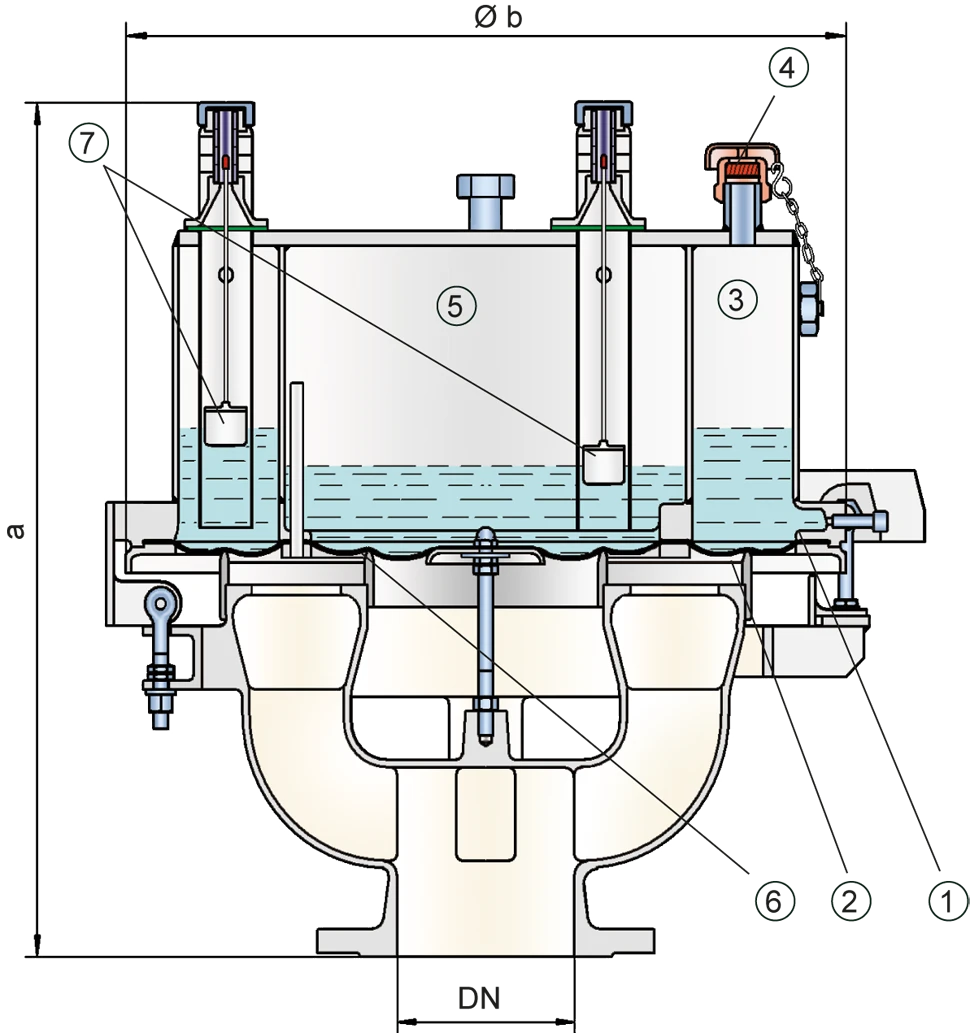
When the pressure in the tank reaches the set pressure, the FPM-diaphragm (1) on the outer valve seat Siège de soupape The valve seat is a component on which the valve pallet rests when the valve is closed. ring (2) is lifted and vapours vent to the environment. The set pressure is adjusted by the liquid (glycol water mixture) column height, which is filled into the outer ring chamber (3). The overpressure Surpression Overpressure refers to an increase in pressure in a system or vessel above the normal operating pressure. chamber is equipped with an opening (4) to keep the pressure in balance with the ambient pressure. If a vacuum builds up in the tank, it is transmitted through pressure balancing tubes into the vacuum chamber (5) (inner chamber). If the set vacuum Set vacuum Internal negative gauge pressure at which a vacuum valve first opens. , which depends on the liquid column height in the vacuum chamber, is reached the atmospheric pressure lifts the diaphragm up off the inner valve seat ring (6). Ambient air can now flow into the tank. The liquid column heights, which affect the set pressures and vacuum, can be checked by floating level indicators (7).

Advanced Sealing Technology for Reliable Pressure Maintenance in Tanks

The tank pressure Pression de la cuve Tank pressure is the pressure within a tank. is maintained up to the set pressure with a tightness that is far superior to the conventional standard due to our highly developed manufacturing technology. This is achieved because the liquid loaded diaphragm presses tightly around the special designed valve seat surface area, even when the operating pressure Pression de service Operating pressure is the pressure existing at normal operating conditions within the system being protected. increases. This is extremely important to reduce leakage to an absolute minimum. After the excess pressure or vacuum is discharged, the valve reseats and provides a tight seal Joint A seal prevents or limits unwanted transfer of product from one container to another. Seal is used as superordinate term for all types of sealing elements. .

Dynamic Flame Arresting Safety at Overpressure Conditions

If the tank pressure exceeds the adjusted set pressure Pression de tarage Adjusted set pressure is the pressure at which a valve opens on a test bench. , as the case may be explosive gas/product-vapour air mixtures exit. The speed at which these mixtures exit the annular gap between the diaphragm and the outer valve seat ring while overcoming the set pressure is much faster than the flame speed. If this mixture ignites, flashback into the tank is prevented. If the mixture flow continues, the dynamic flame arresting feature prevents flashback ignition even in the case of endurance burning.

Many Individual Certifications

Even at relatively low flow rates, which occur during thermal outbreathing, the gap formed by the volumetric flow is so narrow that flames are extinguished in the gap and flashback is prevented. The PROTEGO® UB/SF-IIA1 valve is available for substances of explosion group IIA1 - methane. The valve can be used up to an operating temperature Operating temperature Temperature reached when the equipment is operating under design conditions. of +60°C / 140°F and an operating pressure up to ≥3.5 mbar / 1.4 inch W.C. and meets the requirements of European Tank Design Standard EN 14015 – Appendix L and API 2000 EU conformity according to the currently valid ATEX directive. Approvals according to other national/international regulations on request.
Product Data

Tabela de dimensões

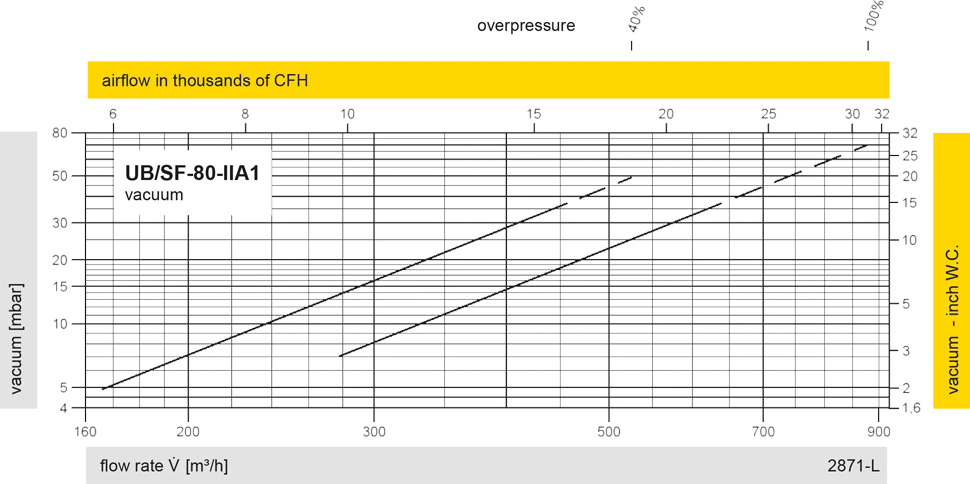
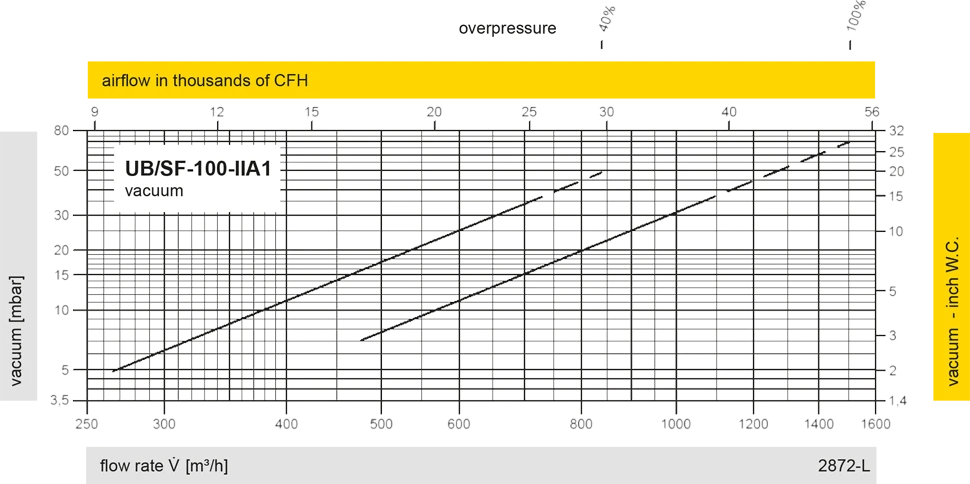
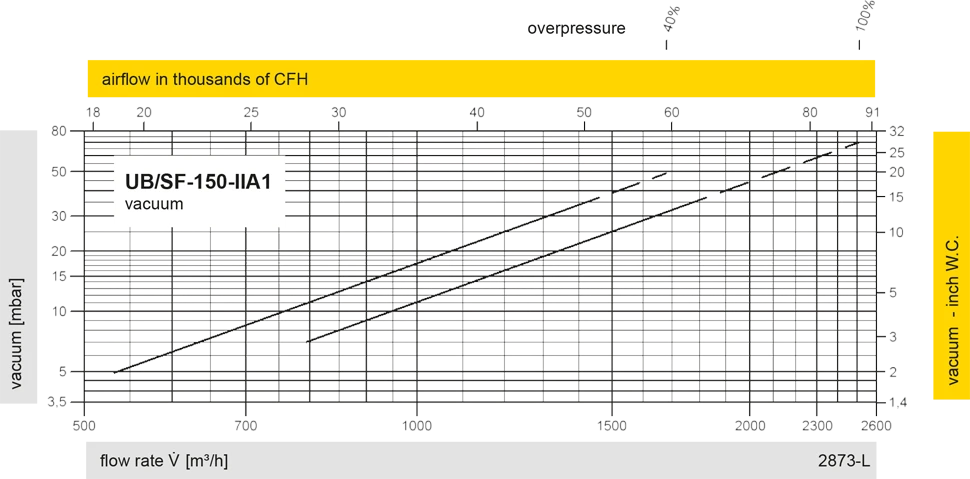
To select the nominal size Diamètre nominal The nominal size is an alphanumeric designation of size for components in a piping system, used for reference purposes, comprising the letters DN followed by a dimensionless integer that is indirectly related to the physical size of the bore or outside diameter of the connections, expessed in millimeters. (DN), please use the flow capacity charts on the following pages

DNpressure pressure 80 / 3" pressure pressure 100 / 4" pressure pressure 150 / 6"
a up to +28 mbar up to +11.2 inch W.C. 615 / 24.21 up to +28 mbar up to +11.2 inch W.C. 645 / 25.39 up to +25 mbar up to +10 inch W.C. 680 / 26.77
a > +28 mbar > +11.2 inch W.C. 765 / 30.12 > +28 mbar > +11.2 inch W.C. 795 / 31.30 > +25 mbar > +10 inch W.C. 830 / 32.68
b 410 / 16.14 485 / 19.09 590 / 23.23

Dimensões em mm

Pressure settings > +50 mbar / +20 inch W.C. (DN 80), > +45 mbar / +18 inch W.C. (DN 100), > +46 mbar / +18.4 inch W.C. (DN150) with additional liquid reservoir - dimensions upon request
Dimensions for pressure/vacuum diaphragm valves with heating coil Serpentin chauffant A heating coil is a pipe connection consisting of several pipe sections. upon request

Seleção do grupo de explosão

MESGExpl. Gr. (IEC / CEN)
≥ 1,14 mmIIA1

Special approvals upon request

Material for housing

Special materials upon request

Tipo de conexão flangeada

EN 1092-1; Form B1
ASME B16.5 CL 150 R.F.

other types upon request

Diagrama de vazão
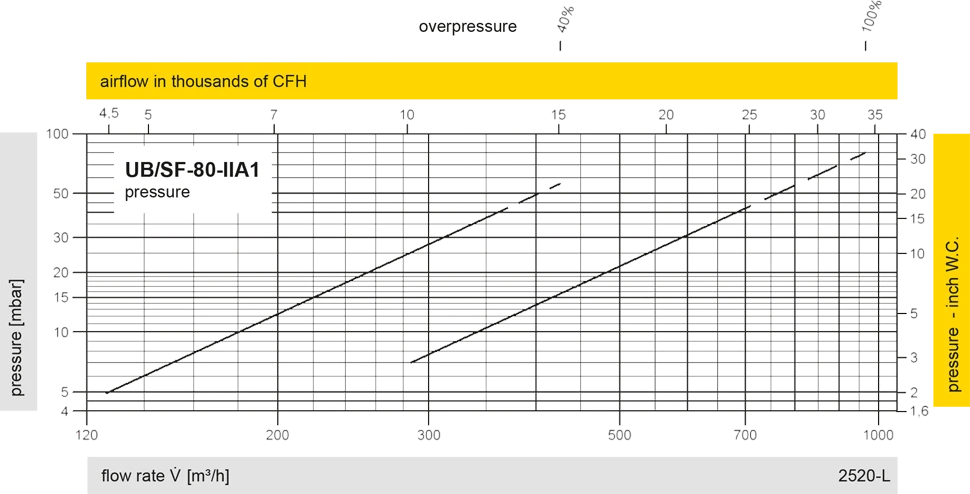
UB/SF DN100
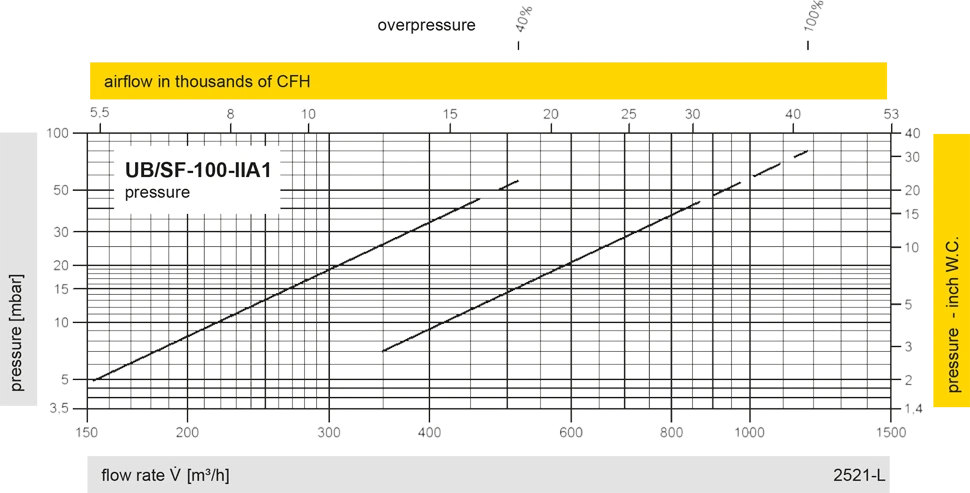
UB/SF DN150
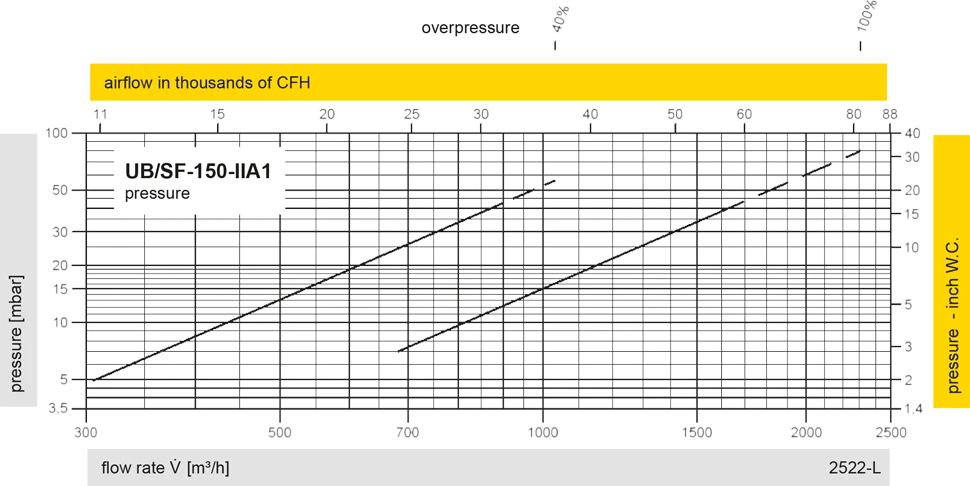
Este diagrama de vazão foi determinado em uma bancada de medição de vazão calibrada e certificada pela TÜV. A vazão V em m³/h se refere ao estado técnico padrão de ar, conforme ISO 6358 (20°C, 1bar). Para conversão em outras densidades e temperaturas, veja o cap. 1: Bases técnicas.
Applications

Armazenamento em tanques

Instalações de processamento químico e farmacêutico

Energia renovável

Tratamento com vapor