


BR/TS-80-IIB-P1,6
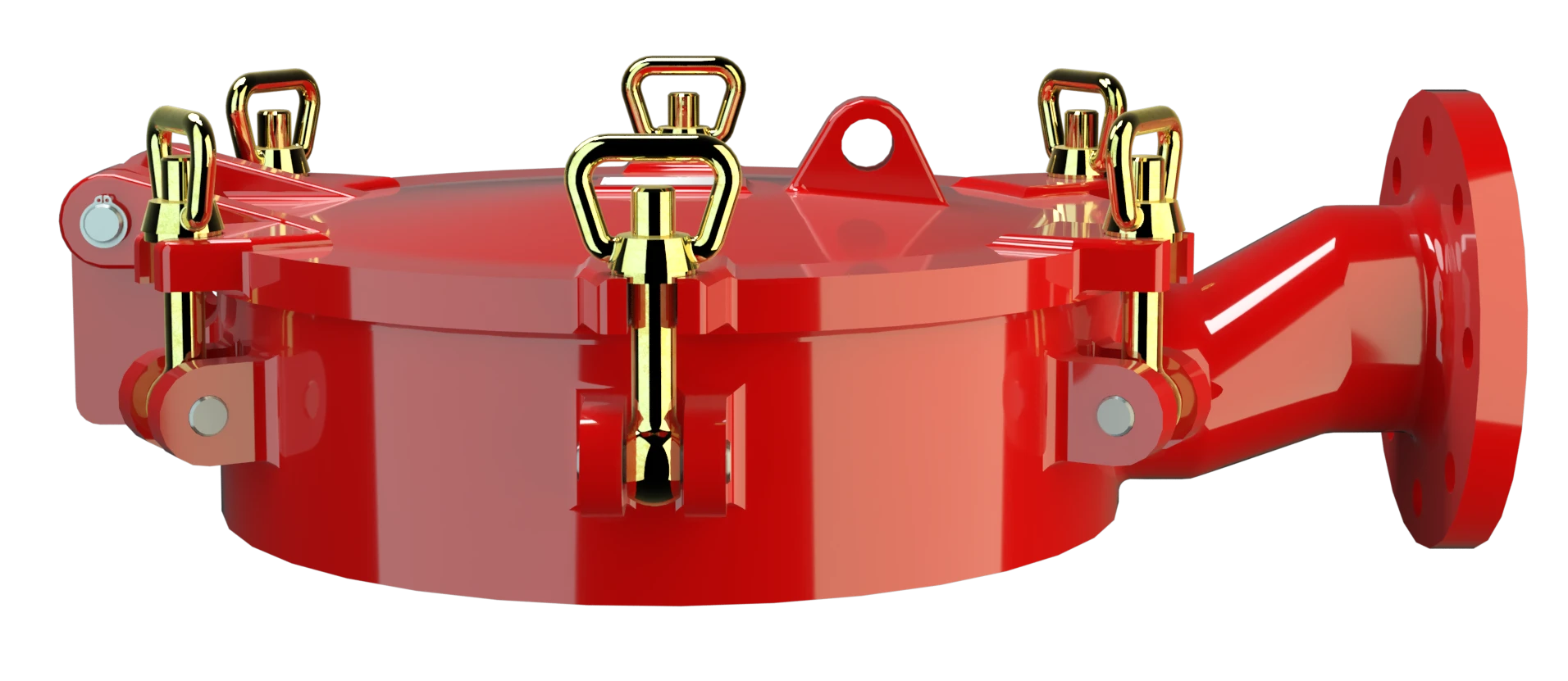
Detonation Flame Arrester for tank ships and containers
Features
Atende a todos os requisitos ADNR*
* Regulamento para o transporte de mercadorias perigosas no Reno
Design plano
Respiro de emergência
Com o corta-chamas montado de forma flexível, permite uso mesmo em condições climáticas adversas e com produtos contaminados
Fácil manutenção
Extraordinariamente fácil de manter
Design modular
Permite a substituição e a limpeza de FLAMEFILTER® individual
Cálculo das taxas de carregamento e descarregamento
Oferecemos suporte no cálculo das taxas de carregamento e descarregamento
Para líquidos inflamáveis
utilizável para praticamente todos os líquidos inflamáveis
Boca de visita para manutenção e limpeza
Pode ser utilizada como abertura de manutenção e limpeza
Peças de reposição
Peças de reposição com excelente custo-benefício
Function and Description
Protection of Tanker Ships and Containers
The PROTEGO® BR/TS-80-IIB-P1.6 Detonation Flame Arrester was developed for protecting tankships but can also be used for containers. These devices are especially used on tank ships operating on inland waterways or coastal shipping. The
device
Appareil
A device is a pipe component that influences the media flow by opening, closing, or partially shutting off the flow channel or by dividing or mixing the media flow.
is installed on the tank or a pipe section connected to the tank with a
nominal size
Diamètre nominal
The nominal size is an alphanumeric designation of size for components in a piping system, used for reference purposes, comprising the letters DN followed by a dimensionless integer that is indirectly related to the physical size of the bore or outside diameter of the connections, expessed in millimeters.
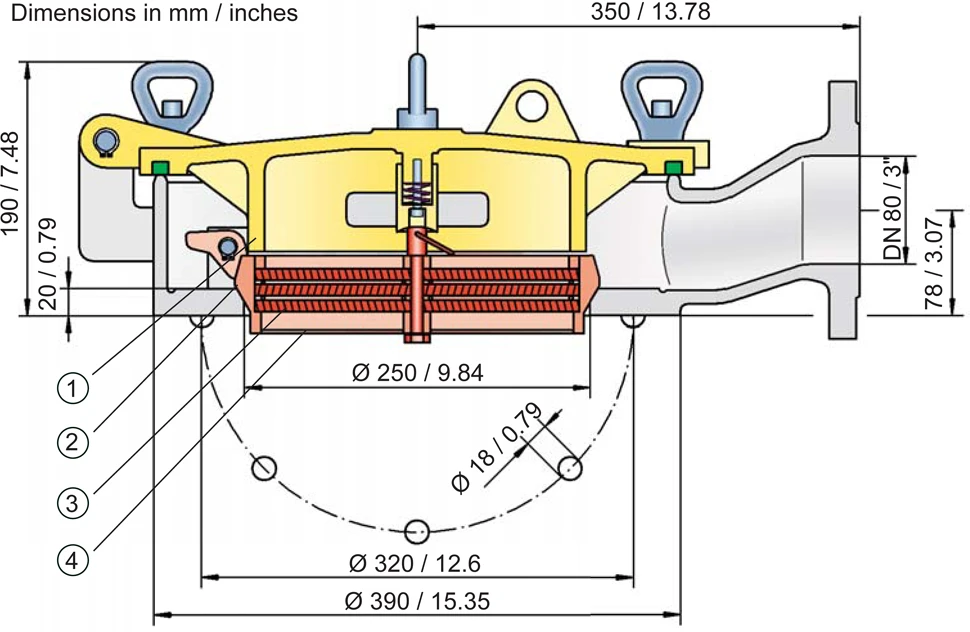
of 250 mm / 10" and connected to the vapour balancing line (DN 80 / 3"). The individual tanks connected via the vapour balancing line are technically decoupled by the
detonation arresters
Arrête-flammes antidétonation
Flame arrester designed to prevent the transmission of a detonation.
and protected.

Main Component – PROTEGO® Flame Arrester Unit
The device protects against unidirectional detonation. In particular, the arrester consists of a
shock absorber
Amortisseur de choc
A shock absorber is a device that reduces the kinetic energy of a detonation.
(1) and the PROTEGO® Flame Arrester Unit (2). The PROTEGO® Flame Arrester Unit consists of several FLAMEFILTER® discs (3) and spacers firmly held in a
FLAMEFILTER® cage
Cage d'éléments arrête-flammes
The FLAMEFILTER® cage is a housing for a FLAMEFILTER® set.
(4). It is moveable and can be folded to the side for maintenance. The primary goal of this design is to enable the tank to be vented or supplied with air in an emergency when ice or crystallizing products clog the FLAMEFILTER®.

For Explosion Groups IIA to IIB
The PROTEGO® BR/TS Flame Arrester is available for explosion groups IIA to IIB (NEC group D to B MESG ≥ 0.5 mm).
The standard design is approved up to an
operating temperature
Operating temperature
Temperature reached when the equipment is operating under design conditions.
of +60°C / 140°F and an
operating pressure
Pression de service
Operating pressure is the pressure existing at normal operating conditions within the system being protected.
up to 1.6 bar / 23.2 psi (absolute), and it meets all the conditions of the ADN* for hazardous goods transport on European Inland Waterways.
EU conformity according to the currently valid ATEX directive. Approvals according to other national/international regulations on request.
Product Data
Seleção do material do corpo
| Design | A | B | |
| Housing | Steel | Stainless Steel | |
| Cover | Steel | Stainless Steel | |
| Gasket | Tankatite | Tankatite | |
| Flame arrester unit Flame arrester unit Flame arrester casing with FLAMEFILTER® set. | A | A |
Material selection for flame arrester unit
| Design | A |
| FLAMEFILTER® cage | Stainless Steel |
| FLAMEFILTER® | Stainless Steel |
| Spacer | Stainless Steel |
Tipo de conexão flangeada
| EN 1092-1; Form B1 |
| ASME B16.5 CL 150 R.F. |
Diagrama de vazão
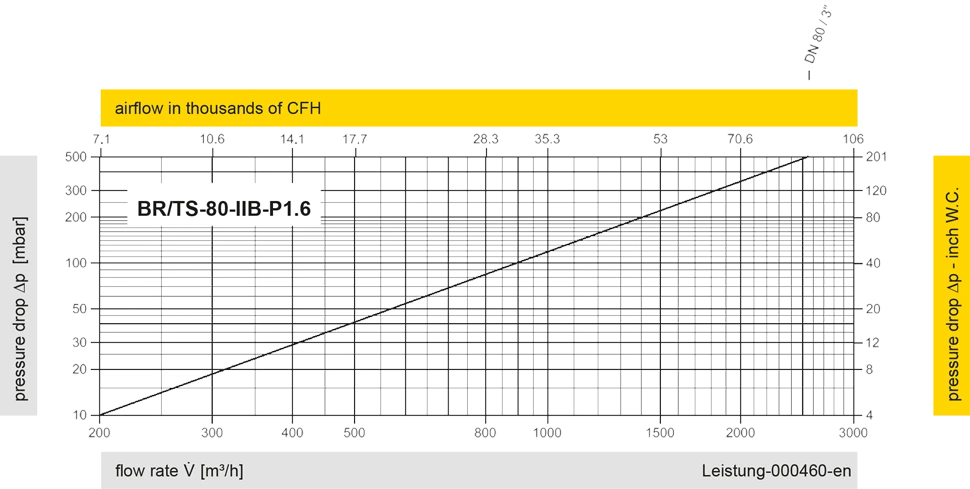
Este diagrama de vazão foi determinado em uma bancada de medição de vazão calibrada e certificada pela TÜV. A vazão V em m³/h se refere ao estado técnico padrão de ar, conforme ISO 6358 (20°C, 1bar). Para conversão em outras densidades e temperaturas, veja o cap. 1: Bases técnicas.


Finding your location…
 PROTEGO®
 Representative
 PARC / Service Partner
No results found