LH/EB
Deflagration Flame Arrester, endurance burning proof, End-of-Line

Features
Comprehensive Weather Protection
Weather Hood With Protection Screen Protects the PROTEGO® Flame Arrester Unit Against Environmental Impact, Such as Nesting Animals and Weather Conditions
Visible Fire Indication by Tilting Weather Hood
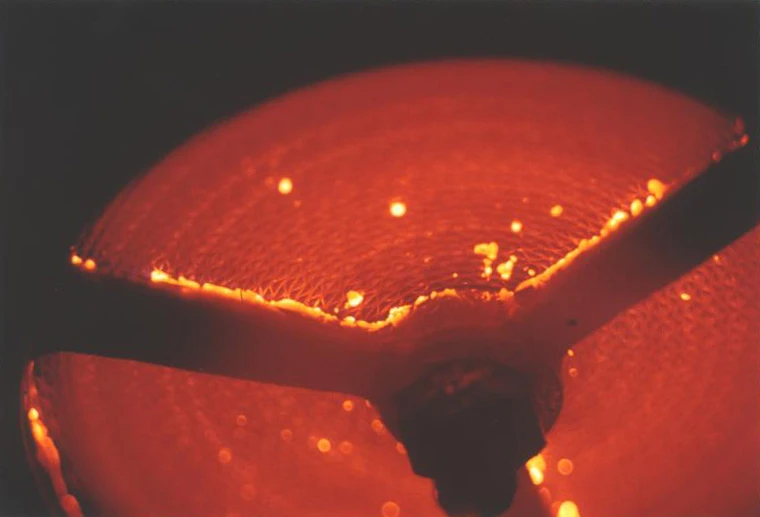
in Case of Fire, the Weather Hood Opens, Allowing the Flame to Be Seen From a Far Distance
Chemically Resistant
Centrally Aligned Melting Element Is Resistant to Chemicals
Safety Against Endurance Burning
Protection against Atmospheric Deflagration and Endurance Burning
Mining
Certificates for Mining are Available
Methane/Air-Mixtures
Most Efficient Deflagration Flame Arrester for Methane/Air Mixtures
Function and Description
Protection Against Atmospheric Deflagration and Endurance Burning of Methane/Air Mixtures
The PROTEGO® LH/EB End-of-Line Deflagration Flame Arrester is used to protect process engineering apparatus and vessels which are not pressurized and process Methane/Air mixtures. The device provides protection against flame transmission through atmospheric deflagration and stabilized flames which can burn for a very long time. This device is specifically applied to vent lines of decommissioned underground mines. Other areas of application are biogas, landfill gas and sewage gas. The device is installed on suction and vent lines, with the goal to prevent flame transmission caused by endurance burning or atmospheric deflagration propagating into the vessel or plant.
Main Component – PROTEGO® Flame Arrester Unit
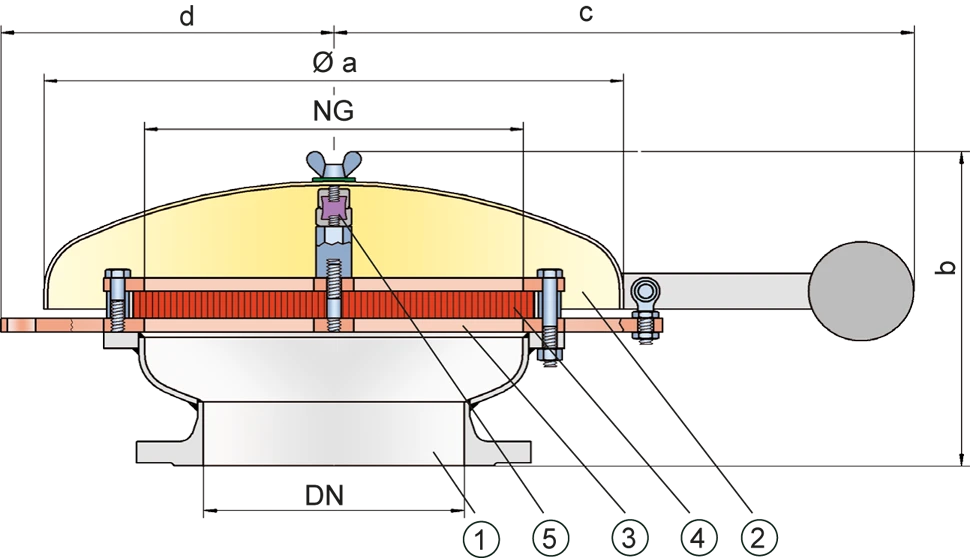
The PROTEGO® LH/EB consists of a housing (1), a weather hood (2) and the PROTEGO® Flame Arrester Unit (3). During normal operation, the metal weather hood is in a closed position. If a flame burns on the Flame Arrester element surface, the fusible link (5), located in a center position, will melt and an externally located weight will move the weather hood into the open position. The PROTEGO® Flame Arrester Unit consists of a FLAMEFILTER® (4), which is installed in a FLAMEFILTER® casing.

For Explosion Group IIA1 - Methan
The PROTEGO® LH/EB Series End-of-Line Deflagration Flame Arrester is available for substances for explosion group IIA1 - methane (former designation Expl.gr. I).
The standard design can be used with operating temperature of up to +60°C / 140°F.
Special certificates for mining are available and the device is type-approved according to ATEX Directive and EN ISO 16852 as well as other international standards.
Product Data
Dimensions
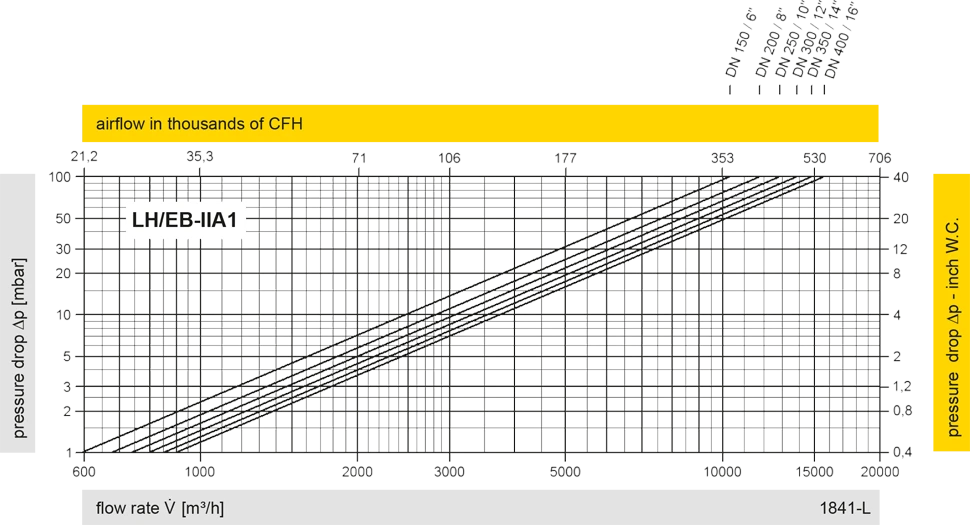
To select the nominal size (DN), please use the flow capacity charts on the following pages
| DN | 150 / 6" | 200 / 8" | 250 / 10" | 300 / 12" | 350 / 14" | 400 / 16" |
| NG | 400 / 16" | 400 / 16" | 400 / 16" | 400 / 16" | 400 / 16" | 400 / 16" |
| a | 600 / 23.62 | 600 / 23.62 | 600 / 23.62 | 600 / 23.62 | 600 / 23.62 | 600 / 23.62 |
| b | 340 / 13.39 | 340 / 13.39 | 340 / 13.39 | 340 / 13.39 | 340 / 13.39 | 340 / 13.39 |
| c | 600 / 23.62 | 600 / 23.62 | 600 / 23.62 | 600 / 23.62 | 600 / 23.62 | 600 / 23.62 |
| d | 350 / 13.78 | 350 / 13.78 | 350 / 13.78 | 350 / 13.78 | 350 / 13.78 | 350 / 13.78 |
Dimensions in mm / inches
Selection of explosion group
| MESG | Expl. Gr. (IEC / CEN) | Gas Group (NEC) |
| > 1,14 mm | IIA1 (I)* | - |
*former designation Expl.gr. I
Special approvals upon request
Material selection for housing
| Design | A | B |
| Housing | Steel | Stainless Steel |
| Weather hood | Steel | Stainless Steel |
| Flame arrester unit | A, B | B |
Special materials upon request
Material combinations of flame arrester unit
| Design | A | B |
| FLAMEFILTER® cage | Steel | Stainless Steel |
| FLAMEFILTER® | Stainless Steel | Stainless Steel |
Special materials upon request
Flange connection type
| EN 1092-1; Form B1 |
| ASME B16.5 CL 150 R.F. |
other types upon request
Flow Capacity Chart
The flow capacity charts have been determined with a calibrated and TÜV certified flow capacity test rig. Volume flow V in (m³/h) and CFH refer to the standard reference conditions of air ISO 6358 (20°C, 1bar). For conversion to other densities and temperatures refer to Sec. 1: “Technical Fundamentals”.