BE/HR-E-IIB3
Deflagration Flame Arrester, endurance burning proof, End-of-Line

Features
Seguridad contra combustión prolongada
para alcoholes e hidrocarburos hasta el grupo de explosión IIB
Apto para buques cisterna marítimos y fluviales
Desarrollado especialmente para buques de navegación marítima, pero también útil para buques de navegación interior y sistemas en tierra firme
Protección integral contra la intemperie
La caperuza con pantalla de protección protege la unidad apagallamas PROTEGO® frente a impactos ambientales, como nidos de animales y condiciones meteorológicas adversas
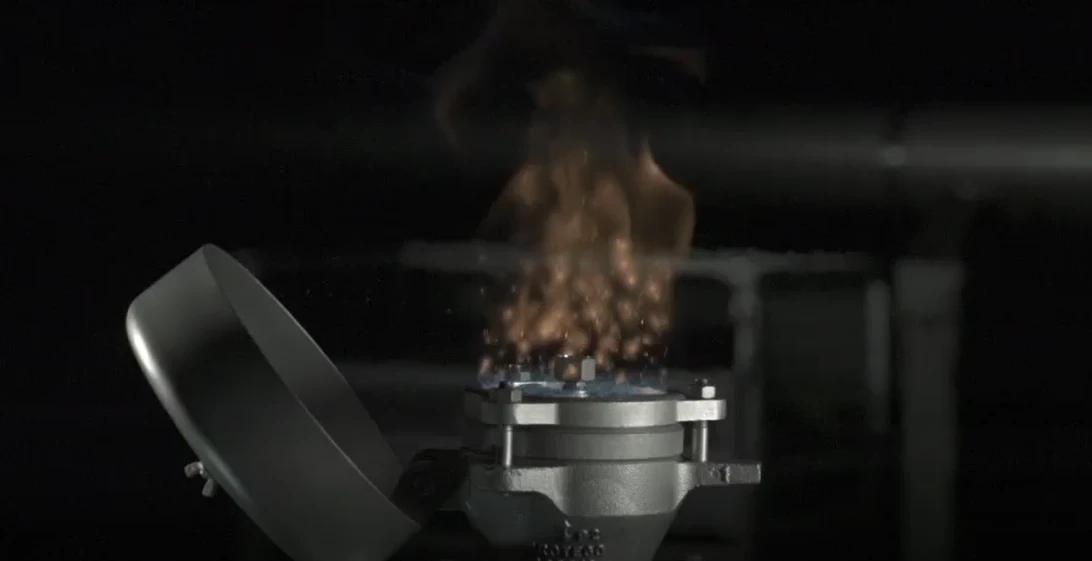
Indicación visible de fuego mediante inclinación de la caperuza protectora contra la intemperie
En caso de fuego, la caperuza se abre, permitiendo que la llama sea visible desde gran distancia
Resistente a productos químicos
El elemento fusible, alineado en posición central, es resistente a los productos químicos
Diseño modular
Permite la sustitución y limpieza de los discos de filtro FLAMEFILTER® de forma individual
Seguridad contracombustión prolongada
Protección contra deflagraciones atmosféricas y combustión prolongada
Piezas de recambio
Piezas de recambio eficientes en costes
Function and Description
Protection of Ethanol and Alcohols in Non-Pressurized Systems and Containers
The PROTEGO® BE/HR-E-IIB3 End-of-Line Deflagration Flame Arrester was specifically developed for vessels which are not pressurized and store Ethanol or other alcohols. The combustion of alcohol requires a modified Flame Arrester element design to provide protection against endurance burning. In addition, the device provides protection against atmospheric deflagration. Main application area is on suction and vent lines, for sea going vessels but also useful for inland navigation vessels with the goal to prevent flame transmission caused by endurance burning or atmospheric deflagration.
Main Component – PROTEGO® Flame Arrester Unit
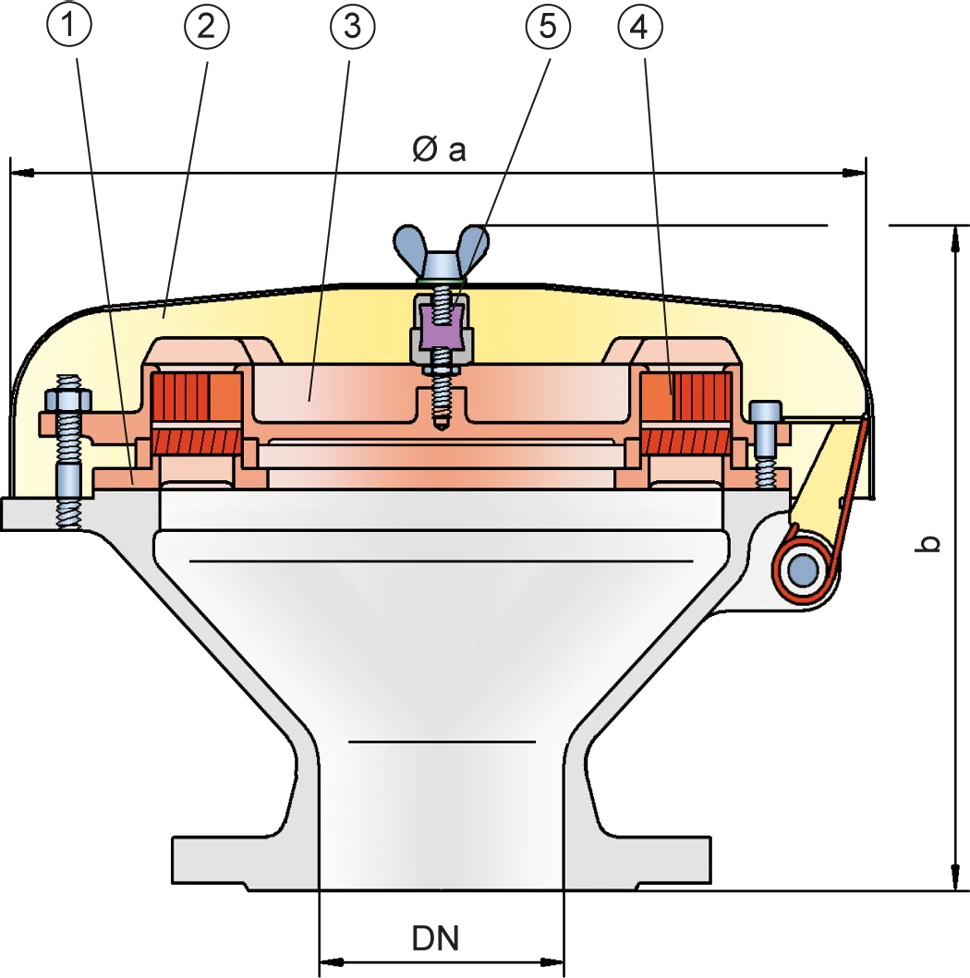
The PROTEGO® BE/HR-E-IIB3 consists of a housing (1), a weather hood (2) and the PROTEGO® Flame Arrester Unit (3). During normal operation, the metal weather hood is in a closed position. If a flame burns on the Flame Arrester Element surface, the fusible link (5), located in a center position, will melt and let the spring loaded weather hood move into the open position. The PROTEGO® Flame Arrester Unit consists of two FLAMEFILTER® discs (4), which are installed in a FLAMEFILTER® casing.

For Explosion Group IIB and Alcohols
The PROTEGO® BE/HR-E End-of-Line Deflagration Flame Arrester is available for hydrocarbons for explosion group IIB3 (MESG ≥ 0,65 mm) and alcohols.
The standard design can be used for operating temperatures up to +60°C / 140°F.
EU conformity according to the currently valid ATEX directive. Approvals according to other national/international regulations on request. Approved according to IMO MSC/Circular 677 as well as IMO MSC.1/Circular 1324 and 1325.
Product Data
Dimensiones
To select the nominal size (DN), please use the flow capacity charts on the following pages
| DN | 80 / 3" | 100 / 4" |
| a | 353 / 13.90 | 353 / 13.90 |
| b | 250 / 9.84 | 250 / 9.84 |
Dimensiones en mm / pulgadas
Dimensions for Deflagration flame arrester with heating jacket upon request
Selección del grupo de explosión
| MESG | Expl. Gr. (IEC / CEN) | Gas Group (NEC) |
| ≥ 0,65 mm | IIB3 | C |
Special approvals upon request
Selección de materiales para la vivienda
| Design | B | C |
| Housing | Steel | Stainless Steel |
| Weather Hood | Steel | Stainless Steel |
| Flame arrester unit | A | A, C |
Special materials upon request
Combinación de materiales para la unidad apagallamas
| Design | A | C |
| FLAMEFILTER® cage | Stainless Steel | Stainless Steel |
| FLAMEFILTER® | Stainless Steel | Hastelloy |
| Spacer | Stainless Steel | Hatelloy |
Special materials upon request
Tipo de bridas de conexión
| EN 1092-1; Form B1 |
| ASME B16.5 CL 150 R.F. |
other connections upon request
Diagrama de flujo volumétrico
Los diagramas de flujo volumétrico han sido determinados con un banco de pruebas de caudal calibrado y certifi - cado por TÜV. El flujo volumétrico V. en [m³/h] y el CFH se refi eren a las condiciones estándar de referencia de aire según ISO 6358 (20°C, 1bar). La conversión a otras densidades y temperaturas están referidas en el Vol. 1: “Fundamentos Técnicos”.